
Click on each core outcome below to explore its expanded definition.
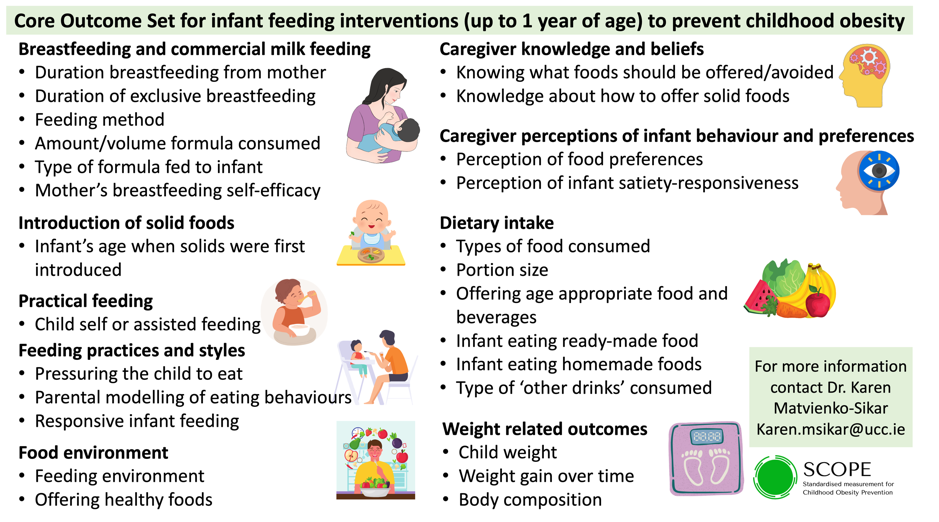
Breastfeeding and formula feeding
Duration breastfeeding from mother
The length of time mothers breastfeeds their infants. This can include the length of time mothers exclusively breastfed their infants or the length of time before mothers ceased all breastfeeding.
Duration of breastfeeding only
Feeding the infant only breast milk, without introducing solids or formula.
Feeding method
The method by which the infant is fed. This can include single feeding approaches or a combination of feeding approaches.
Amount/volume formula consumed
The quantity of formula milk consumed, either per feed or per day.
Type of formula fed to infant
The type of formula provided to infants. (e.g. early baby, hungry baby).
Mother’s breastfeeding self-efficacy
How capable the mother feels about her ability to breastfeed.
Introduction of solid foods
Infant’s age when solids were first introduced
The infant’s age when solids were introduced to the diet. Solids are considered any food or liquid substance, other than breast milk or formula milk.
Parent/Caregiver knowledge and beliefs
Knowing what foods should be offered/avoided
Parent/Caregiver knowledge of what foods should be offered to infants and what foods should be avoided during early feeding.
Knowledge about how to offer solid foods
Parent/Caregiver knowledge of the appropriate ways to feed infants complimentary foods.
Feeding practices and styles
Pressuring the child to eat
Pressuring or cajoling the child to eat more at mealtimes
Parent/Caregiver modelling of eating behaviours
Parent/Caregivers acting as models of eating that children learn to emulate:
- Parent/caregivers who engage in healthy appropriate eating behaviours serve as positive models
- Parent/caregivers who engage in unhealthy eating behaviours serve as negative models
Responsive infant feeding
Infant feeding in which the parent/caregiver is aware of and responds in a timely and appropriate manner to infant cues and needs.
Practical feeding
Child self-feeding or assisted feeding
Whether the child self-feeds (finger foods or spoon use) or is assisted in feeding by the parent/caregiver (spoon fed). This relates to all feeding occasions rather than just introduction of solids.
Food environment
Feeding environment
The environment in which feeding takes place. This includes, but is not limited to, communication with the infant, sitting down to eat with the infant, and turning off the television during feeding
Offering healthy foods
Availability and provision of healthy foods to infant
Dietary intake
Types of food consumed
Relates to the different types of foodstuffs infants consume. This can include ever feeding, and/or the quantity of foods consumed, ranging from fruits and vegetables to sweet and savoury snacks.
Portion size
The size or amount of food provided to infants
Offering age-appropriate foods and beverages
Whether the foods and beverages provided to infants are developmentally appropriate
Infant eating ready-made food
Infant consumption of commercial baby food; this includes pre-packaged, ready-made, or shop-bought foods. These foods can include cereals, fruit, vegetables, fish, meat, sweets and desserts.
Infant eating homemade food
Infant consumption of food prepared by parent/caregiver. This can include the type of food prepared by parent/caregiver for infant.
Type of ‘other drinks’ consumed
Infant consumption of a range of drinks other than breastmilk and infant formula. These include water, cow’s milk and alternatives, sugar sweetened beverages, herbal drinks, tea/coffee and warm drinks (other than tea or coffee)
Parent/Caregiver perceptions of infant behaviour and preferences
Parent/Caregiver perception of food preferences
Perceptions of the infant’s liking of established or newly introduced foods
Parent/Caregiver perception of infant satiety-responsiveness
Perceptions of the infant’s ability to regulate their intake based on their own fullness
Weight related outcomes
Child weight
Including infant’s weight, and weight for age and length
Weight gain over time
The infant’s increase over time in weight
Body composition
Proportion of fat, muscle, bone and water
 SCOPE project